


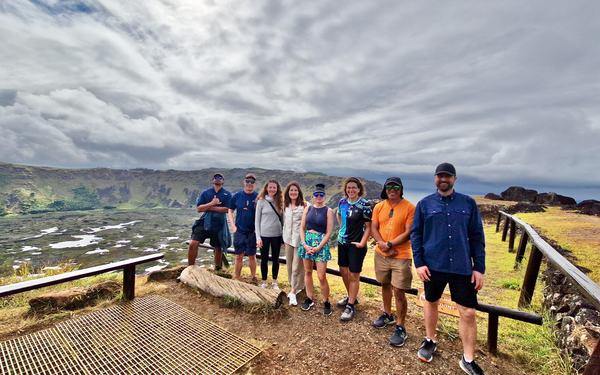
FREYJA Global Team meets in Rapa Nui
FREYJA was hosted by renowned archaeologist and FREYJA co-lead Sonia Haoa and her local research team in Hanga Roa, Rapa …
Read moreResearch Project

Fostering Reciprocity in Environmental DNA science through Yielded stewardship, Just benefit, and Accountability
In Norse mythology, FREYJA is the daughter of Njörður, god of the ocean. FREYJA holds her own agency and territory, symbolic of community sovereignty and stewardship. FREYJA represents fertility and growth, symbolic of renewal and reciprocity. FREYJA can thus represent the tensions and transformations that can arise in shared relationships, and the need to balance benefits, interests and risks. FREYJA reminds us that scientific research is not only about generating new data, but about cultivating trust, yielding power, and co-creating knowledge that benefits both community and science.
Scientific work with ancient eDNA promotes the flourishing of both the planet and people.
This entails that the research and any applied use of scientific results is reciprocal in its approach, taking into account the priorities, needs and knowledge of those governing the lands which are subject to such research and have thus contributed to the benefits which may materialize from applied use of the scientific results.
FREYJA sets out to investigate reciprocity in research, including new pathways for access and benefit sharing, with a particular focus on the context of ancient environment DNA (eDNA). Its multidisciplinary team of experts and researchers will explore into the ethico-legal parameters, cultural perspectives and knowledge translation on research reciprocity in the indigenous communities in Rapa Nui and Arctic Canada with the end view of developing a workable model and practical framework on research reciprocity in the context of eDNA.
FREYJA commenced in October 2025 and is composed of high calibre researchers and partners from the University of Iceland (Iceland), Mata Ki Te Rangi Foundation (Rapa Nui), Te Kotahi Research Institute (New Zealand) and Carleton University (Canada). It is a 24-month research project supported by Wellcome Trust (https://wellcome.org/).
FREYJA's aim is to support the development of ethical, reciprocal and resilient practices with eDNA science by prioritizing the interests and engagement of Indigenous Peoples & Local Communities (IP&LCs) with past and present connections to sample regions.
The project works across four interconnected Working Groups to develop models, frameworks, and practical tools for research reciprocity.
Principal Investigator

Assistant Professor, Faculty of Law
University of Iceland
Hrefna Dögg Gunnarsdóttir is an Assistant Professor at the Faculty of Law, University of Iceland. Her research focuses on statutory requirements for science, ethics and technology, particularly in relation to scientific research in health, the use of health data, research reciprocity, and the welfare of research participants and patients. She holds a PhD in Law from the University of Copenhagen (2023), an MA in Disaster Management from the University of Copenhagen (2018), and Mag. Juris and BA degrees in Law from the University of Iceland. She is affiliated with WELMA – Centre for Legal Studies in Welfare and Market at the University of Copenhagen, and has been a visiting scholar at Harvard Law School and Uppsala University. Her key research interests include human rights, dignity and welfare; health law and research regulation; data governance and sovereignty; and law and ethics regarding emerging technologies. Before entering academia, she practiced as an Attorney-at-Law, having been admitted to the Icelandic Bar Association in 2013.
Co-Principal Investigators
FREYJA is organized into four interconnected Working Groups, each focusing on different aspects of research reciprocity in eDNA science.
To investigate ethico-legal parameters that could exemplify inclusive, respectful and feasible research reciprocity practices in eDNA research and how they support greater Indigenous Peoples & Local Communities (IP&LCs) control of land and data.
To identify and exemplify cultural perspectives, including values, priorities and needs of Indigenous Peoples & Local Communities in relation to eDNA research and how institutional systems and processes can enable greater engagement and sustainable relationships.
To identify and exemplify Indigenous Peoples & Local Communities knowledge related to eDNA research and how institutional systems and processes can enable greater engagement and sustainable relationships.
To develop and test potential practical processes for inclusive, respectful and feasible research reciprocity practices with eDNA science and how institutional systems and processes can promote capacity building and benefit sharing from research collaborations.
Peer-reviewed publications, conference presentations, and research reports contributing to the academic discourse on research ethics and Indigenous data sovereignty.
Practical guidelines and ethical frameworks for researchers, institutions, and communities engaging with eDNA research.
Training materials and educational resources for researchers and community members on ethical eDNA research practices.
Platforms and processes for sharing knowledge between academic institutions and Indigenous communities.
FREYJA is funded by the Wellcome Trust as part of their commitment to supporting research that addresses global challenges in a responsible and ethical manner.
Funded by

FREYJA was hosted by renowned archaeologist and FREYJA co-lead Sonia Haoa and her local research team in Hanga Roa, Rapa …
Read more
Assistant Professor Hrefna Dögg Gunnarsdóttir from the Faculty of Law at the University of Iceland received the Motivation Award for …
Read more
The research project Fostering Reciprocity in Environmental DNA science through Yielded stewardship, Just benefit, and Accountability (FREYJA has gained significant …
Read moreWe'd love to hear from you. Reach out if you have questions about the project or want to learn more.
Send a MessageOr email us directly at freyja@hi.is